English: Reading
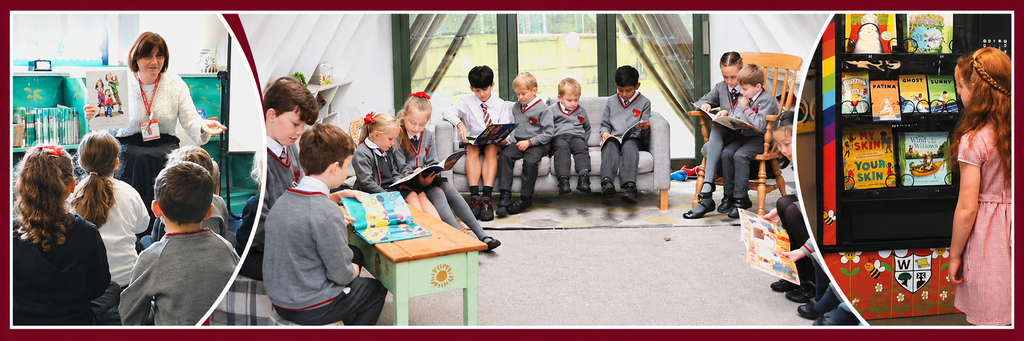
At Woolton Primary School, we believe that every child deserves to become a confident, fluent and enthusiastic reader. Reading opens doors to learning, develops imagination and helps children understand themselves and the world around them.
We want our children to develop not only the skills to read accurately and understand what they read, but also a genuine love of books that stays with them throughout their lives.
Our approach combines the systematic teaching of early reading, regular opportunities to develop fluency and comprehension, and a rich reading culture built around high-quality children’s literature.
How do we teach reading?
At Woolton, we recognise that becoming a successful reader involves much more than recognising words on a page.
Children need to learn how to read words accurately, develop fluency so that reading becomes increasingly effortless, and understand, interpret and think deeply about what they read.
Our approach to teaching reading is firmly grounded in educational research and has been shaped through collaboration with leading experts in primary English education. During 2025–2026, Woolton Primary School led the Liverpool Reading Project, working alongside Dr Wayne Tennent, Senior Lecturer in Education at Brunel University London and author of Understanding Reading Comprehension: Processes and Practices (2025), and Emma Caulfield, education consultant and author of Planning to Teach Writing (2016). Through this work, we brought together leaders from schools across Liverpool to explore the research underpinning effective reading instruction, develop professional understanding and translate evidence into meaningful classroom practice. Our approach is closely aligned with the Department for Education’s Reading Framework (2023) and reflects our commitment not only to implementing evidence-informed teaching, but to contributing actively to the development of excellent practice across our wider educational community.
Across the school, we use consistent teaching strategies and shared language to help children become increasingly confident and independent readers.
Early Reading in EYFS and Year 1
Our reading journey begins in Nursery, where children develop a love of stories, songs, rhymes and books.
Through daily storytelling, shared reading, conversations and playful activities, children develop the listening, speaking and vocabulary skills that provide the foundations for successful reading.
In Reception and Key Stage 1, children learn to read through Read Write Inc. Phonics, a carefully structured programme that teaches children to recognise letters and their sounds, blend sounds together to read words and develop accuracy and confidence.
Children practise reading books that are carefully matched to their phonics knowledge, allowing them to experience success and gradually become more fluent readers.
As children become secure in their early reading skills, they begin to explore increasingly challenging texts, develop their understanding and build their independence.
You can find out more about our approach on our English: Phonics page.
Developing Fluent Readers
Fluent reading is about more than reading quickly. It means reading accurately, smoothly and with appropriate expression so that children can concentrate on understanding the text.
At Woolton, we explicitly teach children what fluent reading sounds like and provide regular opportunities to practise.
Our five key fluency approaches are:
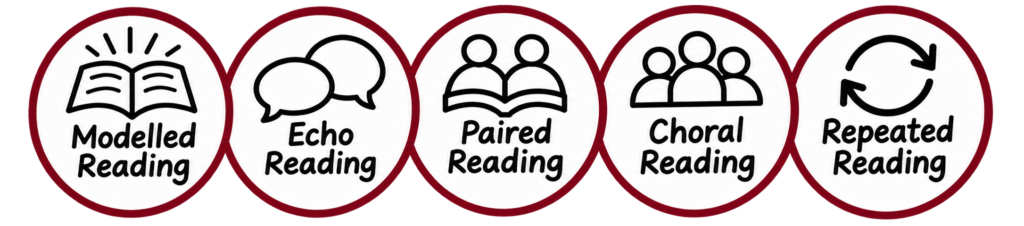
These five approaches to developing reading fluency are informed by the Department for Education’s Reading Framework (2023) and form an important part of how we teach children to read accurately, smoothly and with expression. Through these approaches, children learn to read with accuracy, appropriate pace, natural flow and expression, paying attention to punctuation and meaning.
Understanding What We Read
Reading is about much more than recognising and reading words accurately. Children need to understand what they read, make connections, ask questions, explore different interpretations and think critically about an author’s choices and intentions.
Our work with Dr Wayne Tennent and Emma Caulfield, through the Liverpool Reading Project, has helped us develop a clear, consistent and research-informed approach to teaching reading comprehension across the school. This has led to a greater emphasis on purposeful discussion, explicit teaching of comprehension strategies, careful questioning and opportunities for children to explore and justify their interpretations. Rather than simply answering questions about a text, children are taught how to construct meaning, draw upon evidence, consider different perspectives and develop their understanding through discussion with others.
We teach six key comprehension strategies that help children become thoughtful, independent readers.
- Clarifying: Recognising when something does not make sense and working out its meaning.
- Predicting: Using clues and what we already know to think about what might happen next.
- Questioning: Asking questions to explore and deepen understanding.
- Summarising: Identifying and explaining the most important information.
- Visualising: Creating mental pictures to help us understand and remember what we read.
- Evaluating: Forming opinions about texts and explaining our thinking.

Teachers model these strategies by sharing their thinking aloud, demonstrating how skilled readers make sense of texts.
Children then practise the strategies through discussion, shared reading and independent activities, gradually learning to use them for themselves. Through this approach, we develop active, thoughtful and independent readers who engage deeply with texts, think critically about what they read and recognise that reading is a process of making meaning, not simply finding the right answer.
Asking Questions About Reading
We also use three types of questions to help children think about texts in different ways.
- Looking Questions: Finding information that is directly stated in the text.
- Clue Questions: Using evidence and clues to work out information that is not directly stated.
- Thinking Questions: Exploring ideas, making connections, forming opinions and explaining our reasoning.

These approaches encourage children to look beyond simple answers, use evidence from the text and develop increasingly thoughtful responses to reading.
Reading for Pleasure at Woolton
We believe that reading should be a source of enjoyment, discovery and inspiration.
Throughout their time at Woolton, children are introduced to a wide range of high-quality books, including fiction, non-fiction, poetry, picture books, graphic novels and classic and contemporary literature.
Our classroom libraries and reading curriculum celebrate diverse authors, characters, cultures and experiences. We want every child to find books that reflect their own lives while also discovering new perspectives and different worlds.
Reading for pleasure is encouraged through daily story time, opportunities to choose books, author visits, reading celebrations and special events.
Our unique reading spaces, including Blaise the Bus and The Giant Library Book, help make reading a special and enjoyable part of school life.
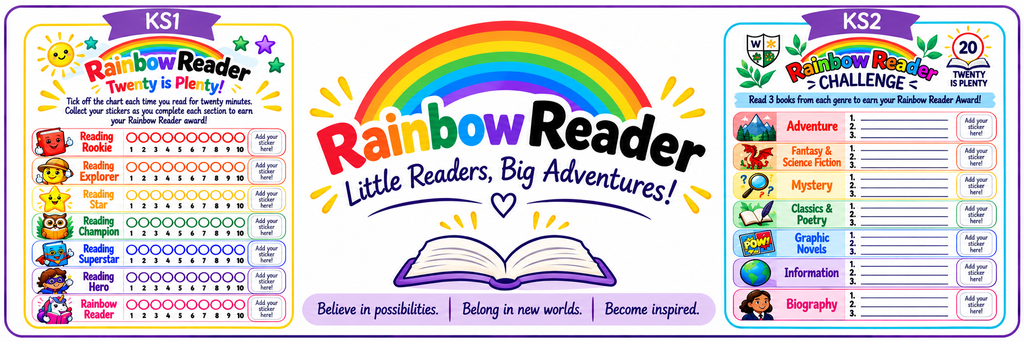
Our Rainbow Reader Challenge
Our Rainbow Reader initiative celebrates children’s reading achievements and encourages them to develop positive reading habits.
In Key Stage 1, children work towards collecting the colours of the rainbow by reading regularly.
Little Readers, Big Adventures!
In Key Stage 2, our Rainbow Reader challenge encourages children to explore seven different genres, helping them discover new authors, broaden their reading experiences and develop their own reading preferences.
Read Wider, Think Bigger!
We celebrate effort, enthusiasm and reading choices, recognising that every child’s reading journey is different.
Reading for Every Child
We recognise that children develop their reading skills at different rates and may need different types of support. Our teachers regularly assess children’s reading to identify their strengths, celebrate progress and plan appropriate next steps. Children who need additional support may receive further phonics teaching, opportunities to practise reading fluently, additional vocabulary teaching or small-group and individual support.
From Year 2 onwards, all children eligible for Pupil Premium funding have access to Lexia, a personalised reading programme that helps children develop their reading skills, build confidence and make progress. Other children are also given access to Lexia when assessments identify that they would benefit from additional support.
From Year 3 onwards, children who need further support with phonics and reading may access Read Write Inc. Fresh Start, a structured programme designed to strengthen reading accuracy, fluency and confidence.
We also recognise the importance of providing appropriate challenge for confident readers. Children are encouraged to explore increasingly demanding texts, consider different interpretations, evaluate authors’ choices and develop a deeper understanding of what they read.
At Woolton Primary School, every child is supported and challenged to achieve success as a reader, developing the skills, confidence and love of reading that will stay with them for life.
How Can You Help Your Child at Home?
One of the most valuable things families can do is make reading a regular, enjoyable part of everyday life.
We encourage families to embrace our Twenty is Plenty approach, aiming to enjoy around 20 minutes of reading each day.
There are lots of simple ways to support your child’s reading development:
- Read together: Share stories, take turns reading or enjoy listening to your child read aloud.
- Talk about books: Discuss characters, events, interesting words and what might happen next.
- Let your child choose: Encourage children to explore books that reflect their interests, including comics, magazines, graphic novels and non-fiction.
- Read aloud to your child: Even confident readers benefit from listening to stories and enjoying books together.
- Celebrate progress: Praise your child’s effort, enthusiasm and growing confidence.
- Make reading part of everyday life: Bedtime stories, library visits, recipes, signs and instructions all provide opportunities to enjoy reading.
Most importantly, keep reading positive. Sharing books should be an enjoyable experience, not a test.
Supporting Your Child’s Reading Journey
If you have any concerns about your child’s reading development, please speak to their class teacher. We are always happy to offer advice, recommend suitable books or suggest activities to support learning at home.
At Woolton Primary School, we want every child to leave us with more than the ability to read accurately. We want them to have the confidence to explore new ideas, the curiosity to ask questions and the enthusiasm to discover the joy of reading.
Our ambition is simple: every child a reader, every reader a lifelong learner.